
Nobody Expected It. Nobody Was Ready. Here's How to Change That.
Charly Triballeau/AFP via Getty Images
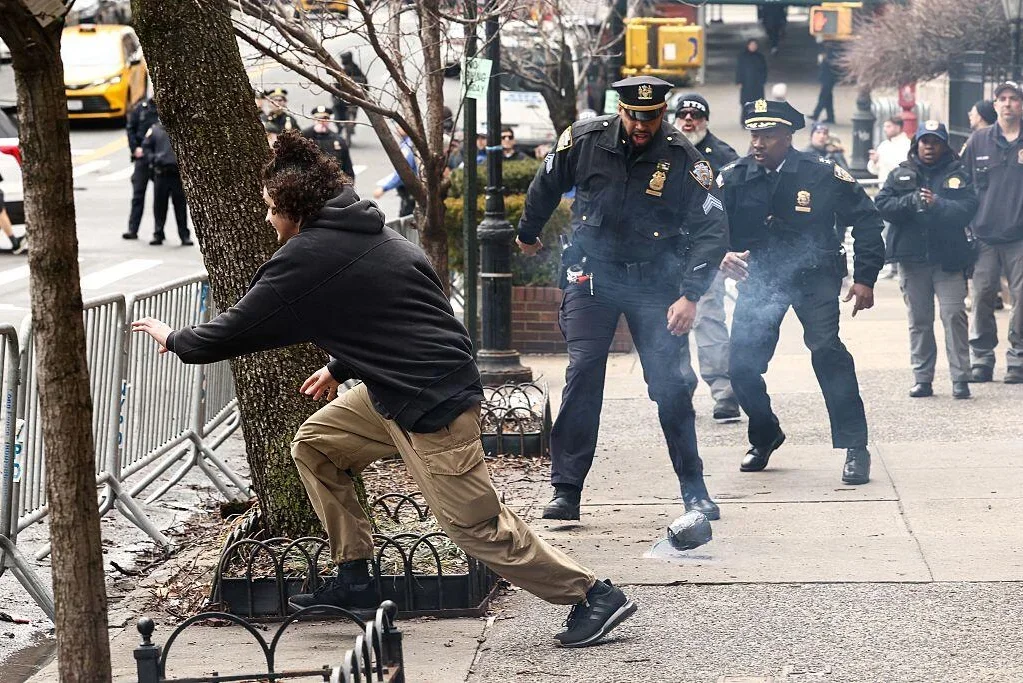
On Saturday, two young men drove from Pennsylvania to Manhattan with homemade bombs and threw them into a crowd of protesters outside Gracie Mansion. One device contained TATP, an explosive used in terrorist attacks around the world, capable of killing or maiming everyone nearby. By a combination of device failure and fast response, nobody was hurt.
That outcome was not guaranteed, and luck, as Mayor Mamdani’s own police commissioner said Monday, is never a strategy.
CitySafe is publishing this case study not to generate fear, but because this incident is a textbook example of what we train for: a sudden, chaotic threat in a public space, surrounded by ordinary people who had no idea it was coming. Understanding what happened and what the people on the ground could have done is exactly the kind of education that saves lives.
What Actually Happened
On the afternoon of March 7th, two protest groups squared off on East End Avenue near 87th Street. A far-right demonstration organized by online provocateur Jake Lang drew roughly 20 people. Counter-protesters gathered across from them. NYPD was present.
In the midst of the standoff, Emir Balat, an 18-year-old high school senior from Langhorne, Pennsylvania, threw a homemade explosive device into the crosswalk. A second device was thrown on the same block. Both devices had been packed with nuts, bolts, and screws. One contained TATP. Neither fully detonated. Officers Aaron Edwards and Sergeant Luis Navarro ran toward the lit device, helped evacuate the immediate area, and secured both devices for the bomb squad. Six people were arrested in total. No injuries were reported.
Balat and his associate Ibrahim Kayumi, 19, were charged federally with five counts, including use of a weapon of mass destruction and attempted material support to ISIS. When an officer asked Balat if he was trying to replicate the Boston Marathon bombing, he said he wanted something bigger.
What the Crowd Experienced
This is the part that matters most for everyday New Yorkers: the people in that crowd did not know what was happening. They saw smoke, heard commotion, and ran. That’s a natural human response, but it’s also the response most likely to get you hurt in an actual detonation, where the immediate instinct to run in any direction can send you toward a second device, into traffic, or into a crush of people.
The crowd had no information. No one told them which direction to move. Protest organizers had no emergency communication protocol. People who wanted to help had no idea how.
To be clear, this isn’t a criticism of the people who were there. This is a description of the gap that exists for almost everyone, the space between something going wrong and knowing what to do about it.
What We Teach for Situations Like This
Situational awareness before anything happens
The best outcome in any threat scenario starts before the threat appears. In a crowded public space, a protest, a concert, or a subway platform, take thirty seconds when you arrive to note two things: where the exits are, and what feels out of place. Simple, yet an effective foundation. You’re not being paranoid. You’re doing what security professionals do automatically.
At Gracie Mansion, several witnesses later described seeing the suspects acting strangely before the devices were thrown. That behavioral recognition, someone moving against the crowd, handling an object with unusual focus, wearing clothing inconsistent with the weather, is trainable. It’s also the earliest possible intervention point.
When Something Happens, Move, Don’t freeze
The human brain’s default response to sudden danger is to pause and try to make sense of what’s happening. That pause costs you seconds you may not have. The rule we teach is simple: if you hear an explosion, see smoke, or witness sudden crowd panic, move away from the source, low and fast, without waiting for confirmation of what it is. You can be wrong and feel embarrassed later.
Move laterally if possible, not directly away in a straight line. In an explosive scenario, fragmentation travels outward from the point of detonation. Distance and angle are both your friends.
Don’t Run Blindly, Pick A Direction
Crowd crushes kill people. When everyone runs at once with no shared direction, the danger often shifts from the original threat to the stampede itself. If you’re near the front of a crowd and something happens behind you, resist the pull to turn and run with everyone else. Move to the side, find a wall or a doorway, and let the crowd pass.
If you’re with others, friends, family, or colleagues, designate a meeting point before you enter any large public gathering. Repeat this to your group before you enter: “If something happens, meet at (your chosen corner/entrance/landmark).” It takes three seconds and eliminates one of the most paralyzing moments in a chaotic evacuation: not knowing where the people you care about are.
Suspicious Objects: Don’t Touch, Don’t Linger, Do Report
One device at Gracie Mansion was found later, in a car parked three blocks away. A third potential device was discovered the next day. The threat radius of an incident like this extends beyond what you can see in the moment. If you see an unattended bag, a mason jar, or any object that seems deliberately placed and doesn’t belong, move away from it and call 911 immediately. Don’t touch it, don’t move it, don’t wait to see if someone claims it.
After You’re Clear, Help Without Becoming A Casualty
The instinct to go back and help is admirable. It’s also dangerous if you do it without information. Once you’ve reached safety, call 911 if you haven’t already, and stay put until emergency services have assessed the scene. The second wave of harm in incidents like this often comes from well-meaning bystanders re-entering a zone that isn’t clear.
If someone near you is injured and you’re already in a safe location, basic first aid, such as stopping bleeding, keeping someone calm and still, is something every person can learn. Our training programs include this. It’s not complicated. It just has to be practiced before the moment arrives.
The Bigger Picture
The last time an IED was deployed against people in New York City was 2017, when Akayed Ullah detonated a device in the tunnel connecting Port Authority to the Times Square subway station. Nine years passed between that incident and this one. That’s not a long time, and as NYPD Commissioner Tisch noted, the city has been in a heightened state of alert since the start of hostilities in Iran.
These incidents don’t announce themselves, and they don’t happen on a schedule. They happen on a Saturday afternoon at a protest, to people who came out to exercise their right to free assembly and had no reason to expect anything other than a loud, tense afternoon.
The people who responded best at Gracie Mansion on March 7th, the two officers who ran toward the device, the bystanders who moved quickly and didn’t panic, were people whose training or instinct kicked in before their fear did. That’s a trainable skill, and it’s one that every New Yorker can build.
Our 2026 Violence Prevention Series runs from March through July, with one free workshop in each borough. The next session is on March 21st in Manhattan.
Community organizations, elected officials, and civic leaders interested in partnering with us are welcome to do so.
Sources
NYC Mayor’s Office — Press Conference Transcript, March 9, 2026. nyc.gov
ABC News — Suspects charged in alleged “ISIS-inspired” attack near NYC’s Gracie Mansion, March 9, 2026. abcnews.go.com
CNN — What we know about 2 terror suspects accused of tossing makeshift bombs near NYC Mayor’s home, March 10, 2026. cnn.com
CBS New York — Suspects charged in alleged “ISIS-inspired” attack near NYC’s Gracie Mansion, March 9, 2026. cbsnews.com
amNewYork — Gracie Mansion terror plot: Suspects face federal charges, March 9, 2026. amny.com